
Trademark & IP Software for the GCC and Middle East
IP practices across the UAE, Saudi Arabia, and the wider Gulf rarely file in just one country. Here's what regional trademark software actually needs to get right.
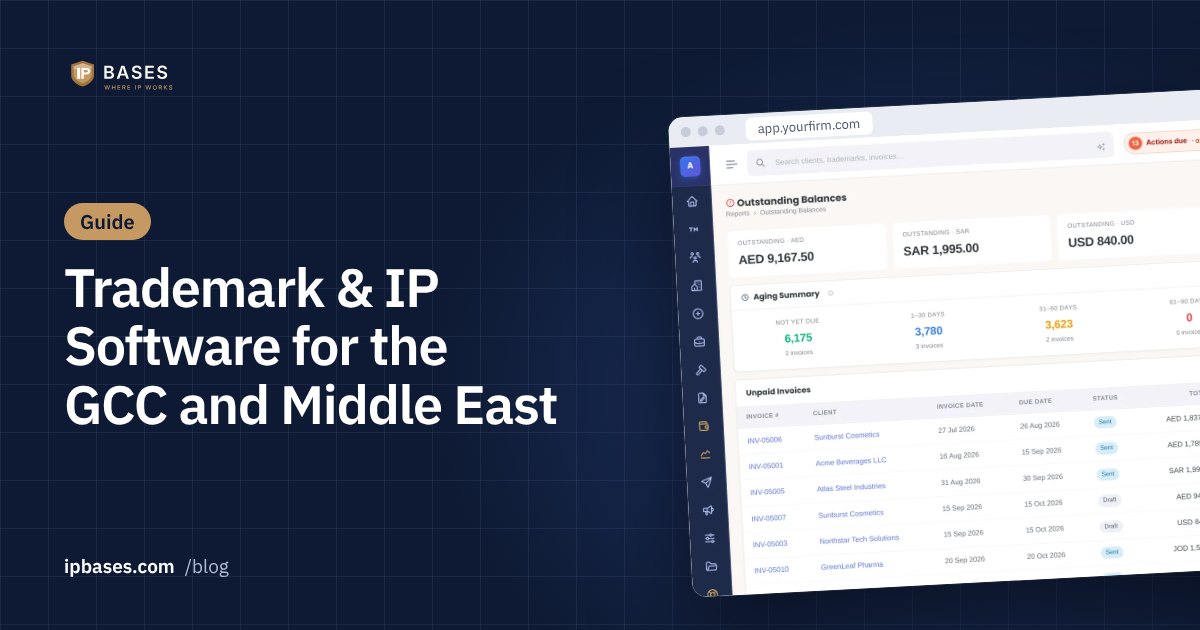
Why regional trademark work needs more than a generic system
A firm searching for trademark software UAE, trademark software Saudi Arabia, trademark registration in GCC countries, or more broadly GCC IP software is usually running into the same limitation: most trademark platforms are built around a single-jurisdiction, English-only assumption, and that breaks down quickly once a portfolio spans the UAE, Saudi Arabia, Qatar, Kuwait, Bahrain, Oman, and often Egypt, Jordan, and Iraq as well.
None of these gaps are exotic edge cases for a firm operating in the region — they're the default. Middle East trademark software needs to treat multi-jurisdiction, bilingual, multi-currency work as the normal case, not an add-on.
What GCC-ready trademark software needs to handle
Regional requirements
- Per-country renewal cycles — a UAE renewal window and a Saudi one don't follow the same calendar, and reminder timing needs to reflect that.
- Bilingual records — Arabic trademark software and English Arabic trademark software both point to the same real need: capturing a mark's name in both languages on the same record, not as a bolted-on translation field.
- Multi-currency invoicing — AED alongside other regional currencies, depending on the client and jurisdiction.
- Associate-network billing — much regional trademark work is routed through local associates and correspondent firms, and invoicing needs to route correctly and stay correct as those relationships evolve.
- A jurisdiction-level view of the whole portfolio — which countries the practice's marks are concentrated in, updated live rather than reconstructed for each partner meeting.
Filing across the UAE, Saudi Arabia, Qatar, Kuwait, Bahrain, Oman, Egypt, Jordan & Iraq
Each of these jurisdictions has its own trademark office, its own timelines, and its own procedural quirks — but the software layer sitting on top doesn't need a separate module per country to handle that well. What it needs is a data model where jurisdiction is a first-class field on every mark (not an afterthought), so that renewal timing, reporting, and search all work correctly regardless of which of these countries a given mark is filed in.
This is also why multi-country trademark software and multi-jurisdiction trademark software (covered in more depth in our self-hosted vs. SaaS comparison) matter as much regionally as they do globally — a firm with marks in five GCC countries has effectively the same technical requirement as one with marks on five continents.
Data residency: a regional consideration worth naming directly
For firms handling government, royal, or otherwise sensitive regional clients, where the underlying data actually lives can matter as much as any feature list. Self-hosted trademark software (see our self-hosted vs. SaaS guide) lets a GCC-based firm keep client and filing data on infrastructure physically and legally within reach, rather than a cloud region decided by an overseas vendor.