
Trademark Management Software: The Complete Guide
Everything an IP law firm, corporate legal department, or solo trademark agent needs to know before choosing a system — what it is, what it actually needs to do, and how to evaluate one.
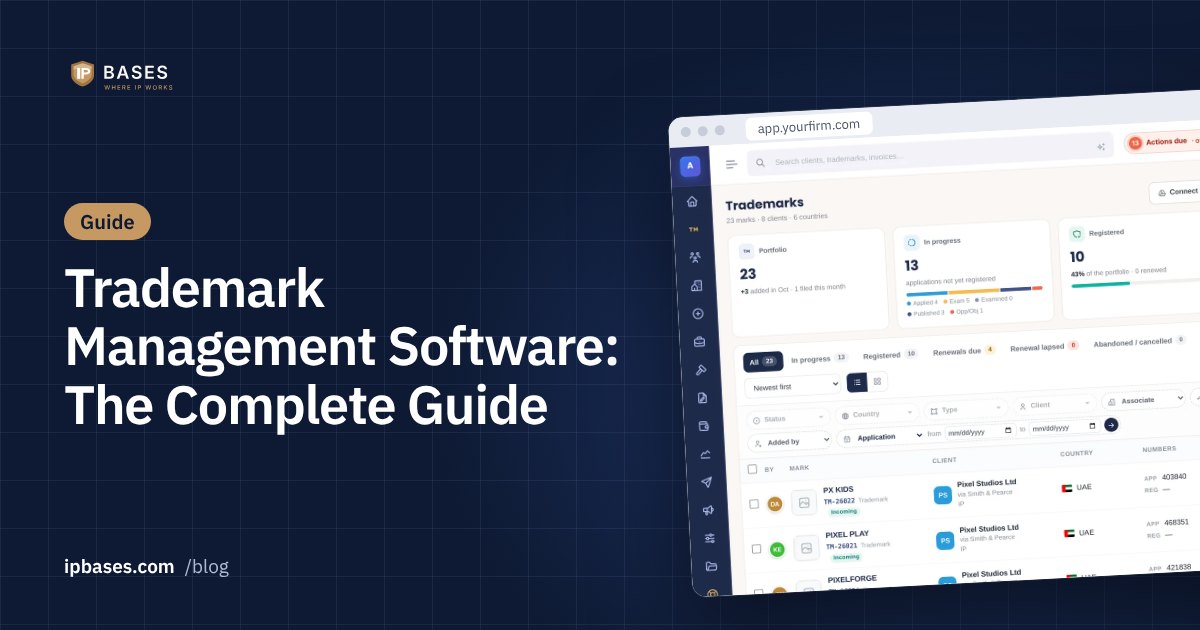
What is trademark management software?
Trademark management software is a system built to track and administer a portfolio of trademarks through their entire lifecycle — from application, through examination and publication, to registration and eventual renewal. It's sometimes called a trademark management system, trademark database software, trademark management solutions, or a trademark management platform — or more broadly intellectual property management software or IP management systems when it also covers patents, designs, or copyrights. Firms managing more than trademarks alone sometimes search specifically for patent and trademark management software, since the underlying need — one record per right, one set of deadlines, one place to bill from — is the same regardless of which IP type it covers.
At a minimum, this kind of software needs to answer three questions reliably: what trademarks does this firm or department hold, what stage is each one at, and what deadline is coming next. Once a portfolio grows past a few dozen marks, a spreadsheet stops answering those questions safely — dates get typed wrong, statuses go stale, and nobody can say with confidence who's responsible for what.
What good trademark tracking software actually does
The phrase trademark tracking software undersells what a modern system needs to cover. A serious platform combines several distinct capabilities into one connected record, rather than treating them as separate tools that happen to be bolted together:
Core capabilities to expect
- A single record per mark — name, class, jurisdiction, status, client, associate, and full history, not scattered across files and email threads.
- Filing workflow — a guided way to add a new application with its documents, invoice, and client notification, rather than four separate steps in four separate tools.
- Docketing and renewal tracking — deadlines calculated automatically from filing data, not typed in by hand.
- Billing tied to the matter — invoices generated from the filing itself, with correct routing when a client is billed via an associate.
- Reporting and analytics — a live view of the whole portfolio: collection rate, renewals due, jurisdiction spread.
- Role-based access — so a paralegal, an attorney, and an accountant each see what's relevant to them.
Trademark management software vs. a spreadsheet
Excel and Google Sheets are still the most common way small and mid-sized practices track trademarks — and for a portfolio of a dozen marks, that can work. The cracks show up at scale: renewal formulas break when someone inserts a row, there's no audit trail of who changed a date, and billing has to be reconciled by hand against a separate invoicing tool.
The honest comparison isn't "software vs. no software" — it's whether the software actually understands trademarks. A generic project-management or CRM tool can hold rows of data, but it doesn't know that a UAE renewal window differs from a US one, or that an invoice should route to an associate rather than the underlying client. Purpose-built trademark software encodes that domain knowledge so the firm doesn't have to rebuild it from scratch in a spreadsheet.
Trademark software pricing: what to actually compare
When people search for trademark software pricing or IP management software pricing, they're usually comparing two very different commercial models without realizing it:
The two pricing models
- Subscription (SaaS) — a recurring per-user or per-firm fee, usually billed monthly or annually, for as long as you use the software.
- Perpetual license — a one-time payment for the software itself, sometimes with an optional annual fee for updates and support afterward.
Over a 5-year horizon, a subscription's total cost is straightforward to project: monthly fee × 60. A perpetual license's total cost is the license fee plus however many years of optional update renewals you choose to buy. For firms that expect to use the system for years, this difference compounds significantly — which is why self-hosted, perpetual-license software has become a serious category of its own rather than a niche alternative.
Which trademark management software is most effective for businesses?
There is no single most effective product — the most effective one is the one that matches how your business actually manages trademarks. A solo brand owner with a dozen marks, an in-house legal team and an IP law firm handling hundreds of client matters need different things.
Whatever the size, these are the tests that separate effective software from a glorified spreadsheet:
- Automatic deadlines — renewal and action dates are calculated from the filing data, not typed in by hand.
- Reminders that arrive early — and reach the right person, not just whoever entered the date.
- An audit trail — who changed which date or status, and when.
- Fit with your portfolio — trademarks only, or patents and designs too; one country or many, including Madrid filings.
- Where the data lives and what it costs over five years — your own server or the vendor's cloud; a subscription or a one-time license.
IPBases is built for IP law firms, trademark agents and corporate legal departments that need filing, deadlines and billing in one record. If that matches your workflow, see trademark management software or pricing. If all you need is a simple list of marks, a lighter tool may be enough.
How to evaluate trademark management software: a short checklist
Whether you're comparing two named products or just trying to figure out what "good" looks like, a few questions cut through most vendor marketing quickly:
Questions worth asking any vendor
- Does a new filing automatically create its own invoice and renewal deadline, or are those separate manual steps?
- Can it handle a client who is billed through an associate, and does that routing stay correct over time?
- Where does the data actually live — your own server, or the vendor's cloud? What happens if you ever want to leave?
- Is there a real audit trail (who changed what, and when) or just a simple activity log?
- Does pricing scale with your team, or is it a flat one-time cost regardless of growth?
What changed in 2026: the bar is higher than docketing
Through 2026, the definition of “complete” trademark management software has expanded well past records and deadlines. When you evaluate systems now, expect these to be built in rather than bolted on:
- A real filing workflow — a guided wizard that takes a matter from record → invoice → deadlines → client notification in one path, including a route choice between national and Madrid Protocol filings.
- Online payments — a “Pay Now” option on invoices in the client portal, with payment confirmed only by verified gateway events.
- Portals for more than clients — view-only, permission-scoped access for foreign associates, so status lists stop being a weekly email chore.
- Automated renewal communication — scheduled reminder emails and grouped per-client renewal notices, with a delivery log.
- Built-in client communication — templated status updates merged from live matter data, sent by email or WhatsApp and logged against the matter.
IPBases shipped all of the above in its 2026 releases — the details are in What’s new in IPBases (2026).
For primary sources on the systems your software must model, see WIPO’s Madrid System and the official Nice Classification — the international class framework every trademark record is built on.